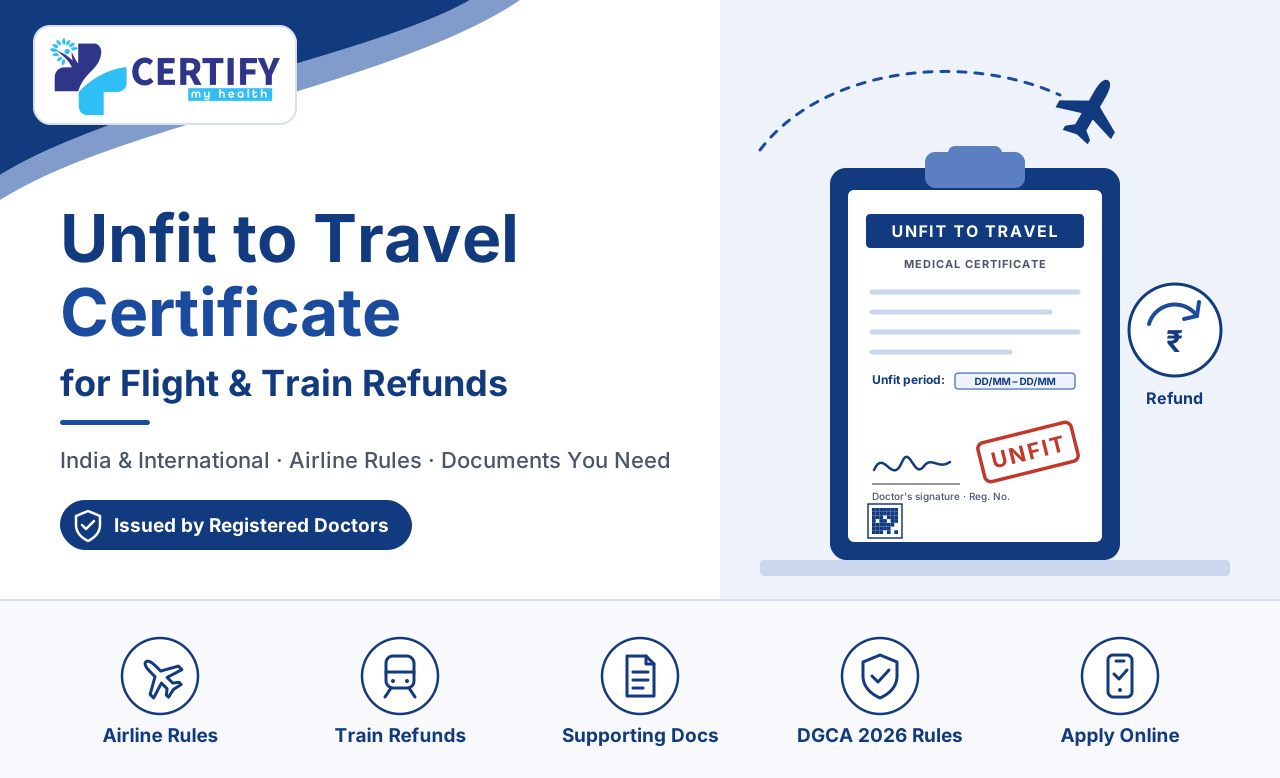
You booked the flight weeks ago. Then a high fever, a fracture, a hospital admission or a sudden diagnosis makes travel impossible. The next question is almost always the same: can I get my money back?
Sometimes, yes. An unfit to travel certificate from a registered doctor is the document airlines and other carriers ask for when you cancel on medical grounds. But it is not a refund guarantee. Whether your claim is accepted depends on how serious your condition is, what supporting reports you attach, and the carrier's own rules.
This guide explains how medical-ground refunds actually work in India and with international airlines, what documents strengthen your claim, and how to get a valid unfit to travel certificate online.
At a Glance
- What it is: A doctor-issued certificate stating you are medically unfit to travel for a specific period.
- Used for: Airline refund, fee waiver or credit shell requests; travel insurance claims; explaining a cancelled trip.
- Refund guaranteed? No. Airlines decide case by case, and serious or life-threatening conditions are the most likely to be accepted.
- Supporting documents: Blood work, scans, discharge summaries or prescriptions are often required alongside the certificate.
- India rule: Under DGCA's 2026 refund rules, hospitalisation cases may get a refund or credit shell; other cases need review by the airline's aerospace medicine specialist.
- Cost: Starts at Rs 599 for submission within India and $24.99 for submission outside India.
- Delivery: Typically within about 90 minutes after consultation, during working hours.
- Key tip: Inform the airline before departure and submit documents promptly.
What Is an Unfit to Travel Certificate?
An unfit to travel certificate is a medical document, issued by a Registered Medical Practitioner after a consultation, stating that you are not medically fit to travel during a specific period. It is the opposite of a Fit to Fly certificate, which confirms you are safe to travel.
People use it to:
- Request a refund, fee waiver or credit shell from an airline after cancelling on medical grounds
- Support a trip-cancellation claim with a travel insurance provider
- Explain a missed flight, train, tour, conference or exam abroad to the organiser
- Request a date change without penalty where the carrier allows it
The certificate records the doctor's medical opinion. The refund decision itself is always made by the airline, the railway or the insurer, under their own rules.
Please Note: A Certificate Does Not Guarantee a Refund
Acceptance or rejection of a medical refund request depends mainly on how serious your medical condition is. Airlines review each case individually, and they are most likely to approve claims involving serious or life-threatening conditions, such as:
- Hospital admission, ICU stay or surgery
- Heart attack, stroke, seizures or a newly diagnosed serious illness such as cancer
- Major fractures or injuries that make travel unsafe
- Pregnancy complications, or contagious illnesses where travel puts others at risk
A mild cold, a minor stomach upset or a condition that does not clearly prevent travel is far less likely to be accepted, even with a certificate.
Supporting documents are often required. Many airlines will not decide on a certificate alone. They frequently ask for blood work, scans (X-ray, CT, MRI, ultrasound), discharge summaries or prescriptions to support the medical certificate. Keep these ready before you file.
What the Indian aviation regulator says
India's Directorate General of Civil Aviation (DGCA) revised its ticket refund rules (CAR Section 3, Series M, Part II, Rev. 3, dated 24 February 2026, effective 26 March 2026). The medical clause works in two tiers:
- Hospitalisation during the travel period: if the passenger, or a family member listed on the same PNR, is admitted to hospital, the airline may give either a refund or a credit shell.
- All other medical situations: a refund is issued only after the airline's own aerospace medicine specialist, or a DGCA-empanelled one, reviews your fitness to travel certificate and gives an opinion.
Two things follow from this. First, the word "may" leaves the outcome with the airline. Second, outside of hospitalisation, your certificate will be reviewed by the airline's own doctor, which is exactly why a clear certificate and supporting reports matter so much. (source)
Airline Medical Refund Rules: India and International
Every airline flying to or from India follows the DGCA refund rules above, but each one runs its own medical review. Policies change often, so always check the airline's current refund page before you file.
|
Airline type |
What applies |
How to request |
|---|---|---|
|
Indian carriers (IndiGo, Air India, Air India Express, Akasa Air, SpiceJet) |
DGCA medical clause: hospitalisation cases may get a refund or credit shell; other cases go to the airline's aerospace medicine specialist. Approval is case by case. |
Cancel through Manage Booking, then submit the certificate and reports through the airline's refund or contact form |
|
Foreign carriers flying to/from India (Emirates, Qatar Airways, Etihad, Singapore Airlines, Lufthansa, British Airways and others) |
Refund rules of the airline's home country, with DGCA refund timelines. Medical waivers are discretionary and usually reserved for serious illness. |
The airline's refund or medical waiver form, or through your travel agent |
|
Tickets booked via a travel agent or portal (MakeMyTrip, EaseMyTrip, Cleartrip and others) |
Under DGCA rules the airline is responsible for the refund, since agents are its representatives. Refunds must finish within 14 working days. |
Raise it with the agent and the airline in writing, and keep copies |
Lessons from real cases
- Timing matters. A Hyderabad passenger diagnosed with a malignant brain tumour weeks before a Qatar Airways flight had his medical waiver rejected as submitted late. A consumer commission later ordered Qatar Airways and EaseMyTrip to refund the tickets and pay compensation, noting the airline's own policy covered serious illness before departure. Contact the airline and agent as soon as you know you cannot travel. (source)
- Wording matters. A US passenger's ITA Airways medical refund was denied because the certificate lacked a prognosis covering the travel dates. A certificate should state the diagnosis, the expected course, and the exact period you are unfit to travel. (source)
- A refund may come as a credit shell or date change. Some airlines offer rescheduling or travel credit rather than cash for medical cases. Under DGCA rules, keeping money in a credit shell is your choice, not the airline's default.
Train Tickets: Indian Railways and IRCTC
Railway refunds work differently from airlines. Indian Railways' refund rules do not give a special full refund for passenger illness on a confirmed ticket, so standard cancellation charges usually apply even with a medical certificate.
What you need to know:
- Cancel in time. For a confirmed e-ticket, no refund is allowed unless you cancel or file a TDR (Ticket Deposit Receipt) online at least 4 hours before scheduled departure. (source)
- Tatkal is strict. Confirmed Tatkal tickets get no refund on cancellation. (source)
- Where the certificate helps: a travel insurance claim for the ticket and other trip costs, or a request to an employer, institution or tour operator affected by the cancelled journey.
If you are ill close to departure, cancel the ticket first to protect whatever refund applies, then get your certificate.
Supporting Documents to Attach With Your Certificate
A certificate tells the airline what the doctor concluded. Supporting reports show the evidence behind it. Attach whatever applies to your case:
- Blood test reports (for example CBC, dengue or malaria tests, infection markers)
- Scans and imaging such as X-ray, CT, MRI or ultrasound reports
- Hospital admission records or discharge summary, if you were admitted
- Prescriptions showing the treatment you were given
- ECG or other test results for heart-related conditions
- Doctor's notes from your treating hospital or clinic, if you saw one in person
- Ticket and booking details: PNR, e-ticket, booking confirmation and cancellation confirmation
- Proof of relationship, if the claim is about a family member on the same PNR
Date all reports clearly. They should fall close to, or before, your travel date.
What a Valid Unfit to Travel Certificate Must Include
Vague certificates are the most common reason for rejection. A strong certificate includes:
- Your full name, age and identifying details
- The diagnosis or nature of your condition
- A clear statement that you are medically unfit to travel, and why
- The exact period you are unfit to travel, with start and end dates covering your travel date
- The expected course of recovery (prognosis), where relevant
- Date of consultation and date of issue
- The doctor's name, qualification and medical registration number
- The doctor's signature or valid digital authentication
Some airlines and insurers have their own medical form. If yours does, share it with the doctor so it can be completed in the required format.
How to Get an Unfit to Travel Certificate Online
You can request an unfit to travel certificate through CertifyMyHealth without visiting a clinic:
- Fill in the online form. Share your symptoms, diagnosis if known, travel date, airline or carrier, and booking details. Upload any reports you already have, such as blood work, scans or discharge summaries.
- Consult a registered doctor. A Registered Medical Practitioner reviews your information and assesses you remotely by chat, call or video.
- Receive your certificate. If the doctor finds you unfit to travel, your signed digital certificate is sent by WhatsApp or email, typically within about 90 minutes during working hours.
A few honest points:
- The doctor decides whether you are unfit to travel and for how long. If your condition does not justify it, the certificate will not be issued.
- We cannot arrange blood tests or scans. If your case needs them, get them done at a local lab or hospital and share the reports during your consultation.
- If your symptoms need urgent in-person care, the doctor will tell you to seek it first.
Cost, Timing and Common Rejection Reasons
An unfit to travel certificate from CertifyMyHealth starts at Rs 599 for submission within India and $24.99 for submission outside India. Delivery is typically within about 90 minutes after the consultation, during working hours.
File as early as possible. Tell the airline before departure that you cannot travel, cancel or hold the booking as the airline advises, and send your documents promptly. Late submission is one of the easiest ways to lose a claim.
Common reasons medical refund requests are rejected:
- The condition does not appear serious enough to prevent travel
- No supporting reports were attached
- The certificate does not cover the travel date, or gives no clear unfit period
- The request was sent after departure, or long after the illness
- The doctor's registration number or signature is missing
- The fare rules allow only a credit shell or date change, not a cash refund
If your request is refused, ask the airline for the reason in writing and whether more documents would help. You can escalate through the airline's grievance officer, the AirSewa portal for flights in India, or a consumer forum.
Frequently Asked Questions
Can I get a full refund on a non-refundable ticket with an unfit to travel certificate? Sometimes. Airlines can waive fees or refund non-refundable fares on medical grounds, but it is at their discretion. Serious conditions backed by medical reports have the best chance.
Which medical conditions are most likely to be accepted? Serious or life-threatening ones: hospital admission, surgery, heart attack, stroke, a new serious diagnosis, major fractures or pregnancy complications. Minor illnesses are often rejected.
Do I need blood tests or scans along with the certificate? Often, yes. Many airlines ask for blood work, scans, discharge summaries or prescriptions as supporting evidence before deciding.
What does the DGCA say about medical refunds? Under DGCA's refund rules revised in February 2026, if the passenger or a family member on the same PNR is hospitalised during the travel period, the airline may give a refund or credit shell. In other cases, the airline's aerospace medicine specialist reviews the fitness to travel certificate before a refund is issued.
Does this apply to international airlines? Foreign airlines flying to and from India follow the refund rules of their home country, with DGCA refund timelines. Most offer medical waivers only for serious illness, with documents.
I booked through a travel portal. Who handles my refund? Under DGCA rules, the airline is responsible, because agents are its representatives. Contact both the portal and the airline in writing.
Can I get a refund on a train ticket for illness? Indian Railways has no special full refund for illness on a confirmed ticket. Cancel at least 4 hours before departure to get the standard refund. The certificate is more useful for a travel insurance claim.
When should I get the certificate? As soon as you know you cannot travel, ideally before departure. Late requests are frequently rejected.
Can the doctor refuse to issue the certificate? Yes. The doctor issues it only if your condition genuinely makes you unfit to travel.
Is an online unfit to travel certificate valid? Yes. A certificate issued by a Registered Medical Practitioner after a genuine teleconsultation under India's Telemedicine Practice Guidelines 2020 is valid. Acceptance for a refund still depends on the airline.
Get Your Unfit to Travel Certificate Today
If illness has made your trip impossible, act quickly. Get your unfit to travel certificate online from a registered doctor, attach your reports, and file your refund request before departure.
Disclaimer: This article is for general information only and is not legal advice. Refund decisions are made solely by airlines, railways and insurers under their own policies. CertifyMyHealth issues certificates only after a doctor's assessment and cannot guarantee any refund.