You've signed up for a marathon, a triathlon, a gym membership, or a place at a sports academy—and somewhere in the registration, you're asked for a sports medical certificate, sometimes called a fitness certificate for sports. It's one of the most common entry requirements in organised sport, and also one of the most misunderstood: people aren't sure who actually needs one, whether an ECG is required, how recent it has to be, or where to get it without days of clinic visits.
This guide explains sports medical certificates in plain language: what they are, who needs one, the tests that may be involved (including when an ECG matters), the rules for common events, cost, validity, and how to get one through an online consultation with a registered doctor.
One point to be clear about upfront: a sports medical certificate is a fitness document. It's issued only when a registered medical practitioner, after assessing you, is satisfied that you're medically fit for the activity. The clinical decision always rests with the doctor.
At a Glance
- What it is: A doctor-issued document confirming you're medically fit to take part in a specific sport, event, or physical activity.
- Who needs it: Marathon and race participants, triathletes, cyclists, gym members, swimmers, and applicants to sports academies or trials.
- Tests involved: A general fitness assessment; some events also require an ECG, blood pressure, or other tests depending on the sport, your age, and the organiser's rules.
- Validity: Usually tied to the event and often expected to be issued within 12 months of race day—always check the organiser's exact rule.
- At CertifyMyHealth: Consultation with a registered medical practitioner, digitally signed certificate where appropriate, typically delivered within about 90 minutes during business hours (India), via WhatsApp or email.
- Issued in India: The certificate is provided by an Indian Registered Medical Practitioner (RMP), with valid medical registration details on the document.
- Cost at CertifyMyHealth: €40 only for the sports medical certificate; required diagnostic tests, if any, are arranged separately.
- Delivery: Issued in digital form only, sent via WhatsApp or email.
- Important limit: The certificate is issued only when the doctor assesses you as fit; it can't be bought without a genuine assessment.
Get started on our Sports Medical Certificate page.
What Is a Sports Medical Certificate?
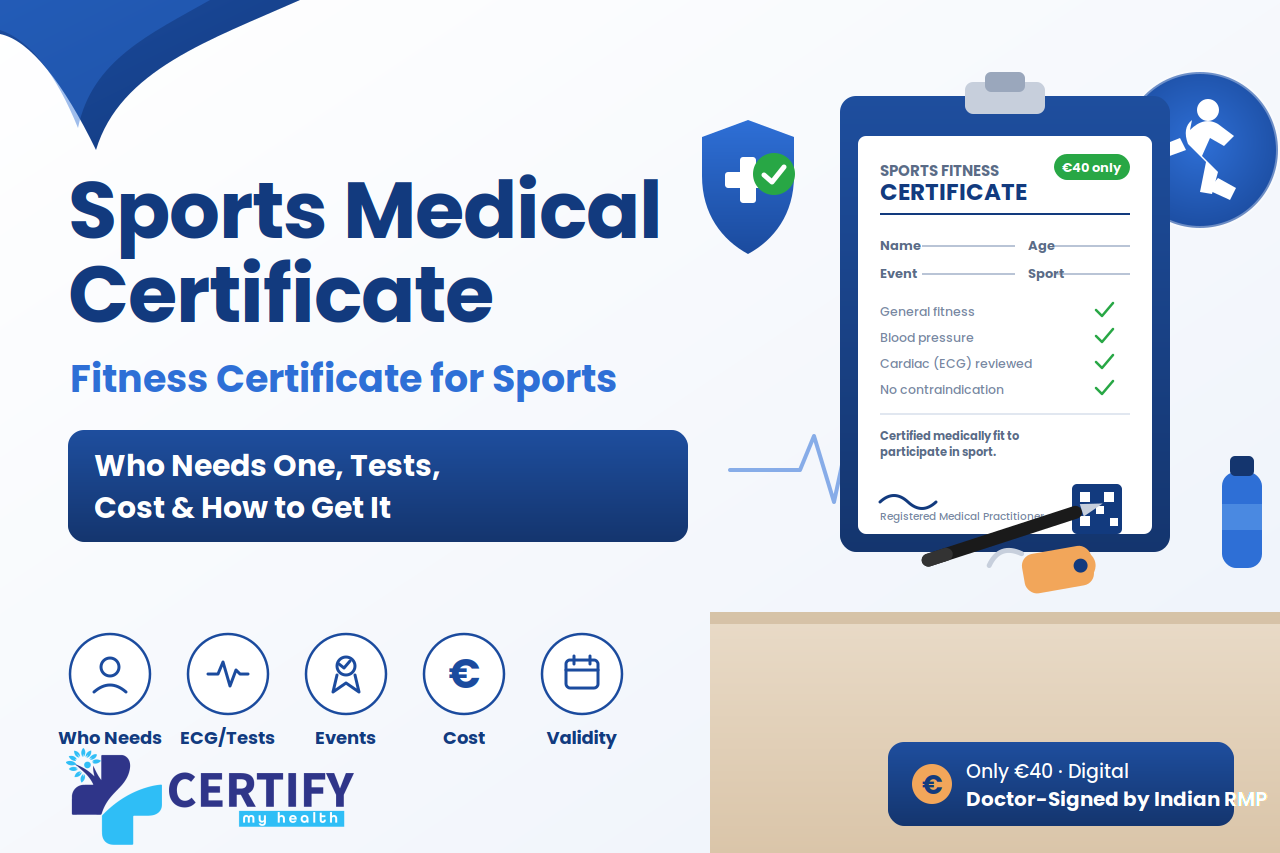
A sports medical certificate—also called a sports fitness certificate, a fitness certificate for sports, a medical fitness certificate for sports, or a "fit to play" certificate—is an official document issued by a registered medical practitioner confirming that you are medically fit to take part in a particular sport or event.
It exists for one core reason: safety. Physically demanding events push the body hard, and organisers have a duty to reduce the risk of a serious health incident during competition. The certificate is their assurance that a doctor has assessed you and found no medical reason you shouldn't participate. A typical certificate records your details, a statement that there is no medical contraindication to your participation, and the doctor's signature, stamp, and registration/credentials so the organiser can verify it's genuine. You can see what the document looks like among our sample certificates, which include a fitness certificate for competitive sports activity.
Who Needs a Sports Medical Certificate?
You'll typically be asked for one if you're taking part in physically demanding or competitive activity. Common situations include:
- Marathons, half-marathons, and running events—one of the most frequent requirements.
- Triathlons and Ironman events.
- Cycling races, sportives, and gran fondos.
- Swimming competitions.
- Gym memberships and fitness programmes, where some facilities ask for medical clearance.
- Sports academy admissions and selection trials—a fitness certificate for a sports academy is a common enrolment requirement.
- School, college, and club sports participation.
- Adventure and endurance activities, such as treks, where a fitness certificate is often required.
Even amateurs and beginners are frequently asked for one—local races, training programmes, and academy trials commonly require clearance, not just elite competition.
Do You Need an ECG or Other Tests?
This is the question that causes the most confusion, so it's worth being precise.
Many sports certificates are issued after a general medical fitness assessment—your history, blood pressure, and a check for conditions that would make strenuous activity unsafe. For a lot of gym, academy, and recreational purposes, that's all that's required.
However, some events specifically require additional diagnostic tests, most commonly a resting or exercise ECG, and sometimes spirometry (lung function), blood pressure readings, or urine analysis. Whether you need them depends on three things: the sport (endurance and high-exertion events are stricter), your age (many events require an ECG for older participants), and the organiser's published rules.
A practical point about online services: an online provider issues the certificate based on your assessment and any test results you provide, but generally does not arrange the diagnostic tests themselves. If your event requires a recent ECG or spirometry, you'll usually get that test done locally and share the results, which the doctor then reviews as part of issuing the certificate. Always read your event's medical requirements early, so there's time to arrange any test before the deadline.
Event-Specific Requirements
Requirements vary widely by event and country. A quick orientation to the most common cases:
Marathons and running events. Many organisers ask for a doctor-signed certificate confirming fitness to run, often required to be recent (commonly within 12 months of race day) and sometimes needed to collect your race bib. Endurance distances and older age brackets are more likely to require an ECG.
Triathlons and Ironman. These combine swimming, cycling, and running, so requirements tend to be stricter, and event series may have their own medical forms to complete.
Cycling sportives and gran fondos. Competitive cycling events, especially in Europe, commonly require a certificate valid within 12 months, and some require an ECG for riders over 40.
Gym and recreational activity. Usually the lightest requirement—a general fitness clearance, particularly for new members disclosing a health condition.
Academies, trials, and "fit to play." Clubs, camps, and academies often ask for clearance before you start a programme or return to play after injury; some require cardiac screening depending on the sport.
A Note for Europe: France & Italy
If your event is in Europe, the rules can be stricter and are sometimes set by law rather than the organiser. Italy is the most demanding: competitive events under CONI regulations typically require a certificate backed by an in-person ECG and spirometry. France has its own framework—for many affiliated running events, adult participants complete the Parcours Prévention Santé (PPS) health questionnaire online rather than submitting a traditional certificate, while many cycling sportives, triathlons, and non-affiliated events still require a doctor-signed certificate. Because these rules change and vary by event, always check your specific organiser's current requirement.
CertifyMyHealth also supports athletes needing certificates for European events—see our dedicated sports medical certificate for Europe information.
How to Get a Sports Medical Certificate Online
Getting a sports medical certificate begins with a consultation. Through CertifyMyHealth, the process is straightforward:
Step 1: Select the service and complete your request. Choose the sports medical certificate and provide your details and the event you're participating in.
Step 2: Share event requirements and any test results. Tell the doctor about the sport and event, and upload any results your event requires—such as an ECG—so they can be reviewed as part of the assessment. If your event has its own medical form, share it.
Step 3: Medical assessment. A registered medical practitioner reviews your information and health history, and may ask for more detail before making a clinical decision.
Step 4: Clinical decision. If the doctor is satisfied you're medically fit for the activity, the certificate is prepared and signed.
The certificate is issued by an Indian Registered Medical Practitioner (RMP) and carries the doctor's signature and valid medical registration details, so the organiser can confirm it's genuine. If your event or organisation is outside India, check that a certificate issued by an Indian RMP is accepted for your specific event before applying—acceptance is set by the organiser.
Step 5: Secure delivery. Your certificate is delivered digitally via WhatsApp or email, typically within about 90 minutes during business hours in India. It is provided in digital form only.
Can a Doctor Decline to Issue It?
Yes. A sports medical certificate confirms genuine fitness, so if the assessment raises a medical concern—or if the doctor judges that a diagnostic test or in-person evaluation is needed first—they may decline to issue it or advise further checks. This isn't an obstacle; it's the safeguard working as intended. Screening exists precisely to catch heart, lung, or other conditions before a demanding event, which protects you on race day.
How Much Does a Sports Medical Certificate Cost?
The cost depends on the type of assessment, whether your event requires additional tests, and any event-specific form. The certificate itself is issued in digital form.
At CertifyMyHealth, the sports medical certificate is available at €40 only. Note that if your event requires an ECG or other diagnostic test, that test is usually arranged and paid for separately at a local facility. To apply, see the Sports Medical Certificate page.
How Long Is a Sports Medical Certificate Valid?
There's no single universal validity period—it's set by the event or organisation. A very common rule for races is that the certificate must be issued within 12 months of the event date, and some organisers apply shorter windows. Because the accepted validity is decided by the organiser, always confirm the exact requirement and obtain your certificate close enough to the event to satisfy it.
Why the Doctor Consultation Matters
A sports medical certificate is a medical document, so it must rest on a genuine assessment. During the consultation the doctor evaluates your health history and fitness for the activity, and reviews any test results your event requires, before deciding whether to certify you as fit.
This is what makes the certificate meaningful to organisers and safe for you. A sports certificate should never be treated as a formality that can be issued without an assessment—it's a fitness clearance a registered doctor stands behind.
Frequently Asked Questions
What is a sports medical certificate?
It's a document issued by a registered medical practitioner confirming that you're medically fit to take part in a specific sport, event, or physical activity, with no medical contraindication to participation.
Who needs a sports medical certificate?
Participants in marathons, triathlons, cycling races, swimming competitions, gym programmes, sports academies, trials, and school or club sports are commonly asked for one—amateurs and beginners included.
Do I need an ECG for a sports medical certificate?
Not always. Many certificates follow a general fitness assessment, but some events require an ECG (and sometimes spirometry or other tests), especially for endurance events and older participants. Check your event's rules.
Can I get a sports medical certificate online?
Yes. A registered medical practitioner can assess you online and issue the certificate where clinically appropriate. If your event requires tests such as an ECG, you typically get them done locally and upload the results.
How long is a sports medical certificate valid?
It's set by the event—commonly issued within 12 months of race day, with some organisers applying shorter windows. Always confirm the exact requirement.
How much does it cost?
At CertifyMyHealth, the sports medical certificate is available at €40 only. Any required diagnostic tests are arranged and paid for separately.
How quickly can I get it?
Where the certificate is issued, it's typically delivered within about 90 minutes during business hours in India, via WhatsApp or email.
Can a doctor refuse to issue a sports medical certificate?
Yes. If the assessment raises a medical concern or the doctor judges that further testing is needed, they may decline to issue it or advise additional checks first.
I'm doing an event in France or Italy — is it different?
Yes. Italy's competitive events typically require an ECG and spirometry, and France uses the PPS health questionnaire for many affiliated running events while still requiring certificates for many other events. Check your organiser's current rule.
Who issues the sports medical certificate?
The certificate is issued by an Indian Registered Medical Practitioner (RMP), with the doctor's signature and valid medical registration details on the document. If your event is outside India, confirm your organiser accepts a certificate issued by an Indian RMP.
Can my personal information be kept confidential?
Yes. Your medical and personal information is handled securely and confidentially in line with our Privacy Policy.
Final Thoughts
A sports medical certificate is the fitness clearance that lets you take part in demanding sport safely—required for everything from marathons and triathlons to gym memberships and academy trials. The essentials: it must be issued by a registered doctor after a genuine assessment, some events additionally require an ECG or other tests, and validity is set by the organiser (often within 12 months of the event). Read your event's medical requirements early so you have time to arrange any test.
If you'd rather skip the clinic queue, CertifyMyHealth connects eligible participants with registered medical practitioners for a secure online sports medical certificate consultation, with digitally signed certificates and fast processing where the doctor assesses you as fit.
Getting ready for your event? Start your consultation on our Sports Medical Certificate page.