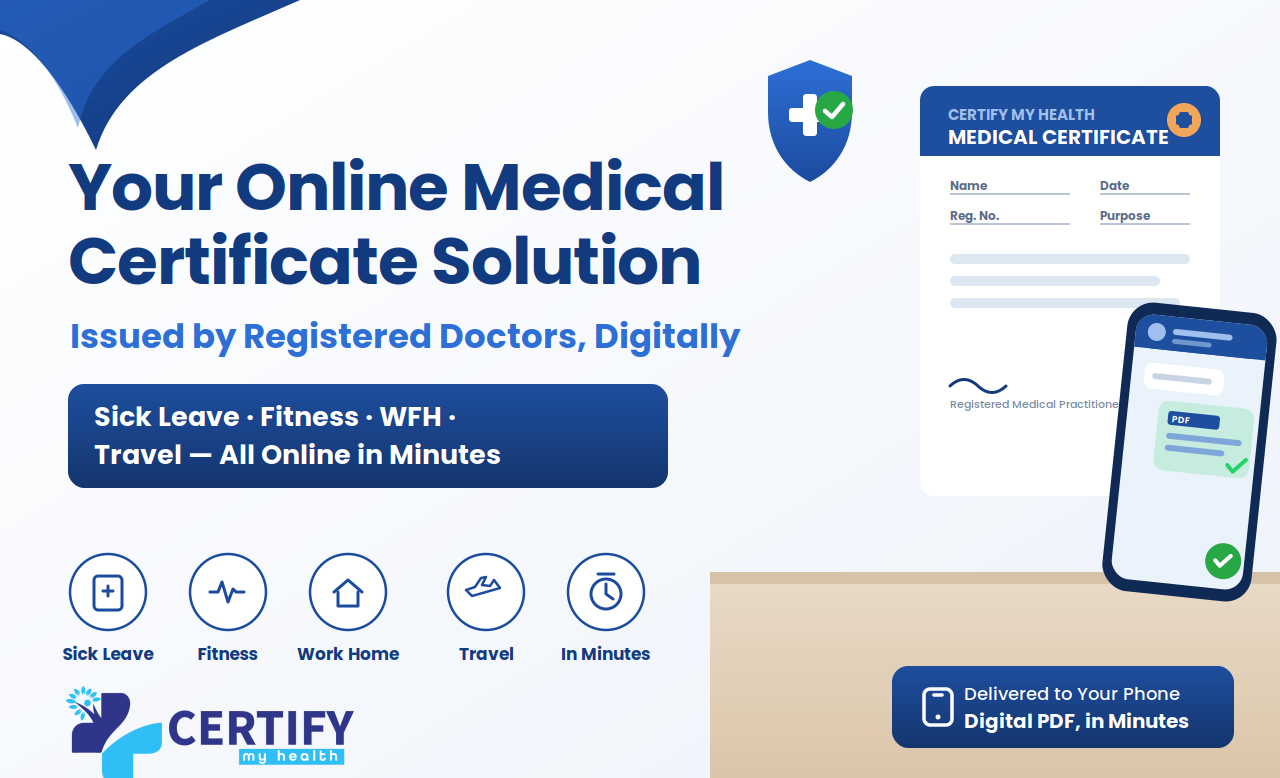
Medical certificates turn up at all sorts of moments in everyday life—a day off work when you're unwell, a fitness clearance before joining a gym or a sport, a document a school or an insurer asks for. Traditionally, getting one meant a trip to a clinic and time in a waiting room. Increasingly, it doesn't: a registered doctor can assess you online and issue the certificate digitally, often within minutes.
This article explains how online medical certificates work in India—what they are, the common types, how the process runs, the different formats you can receive, and what to keep in mind so the certificate is accepted the first time.
What an Online Medical Certificate Is
An online medical certificate is the same document as a traditional one—a formal record of your health status, issued by a registered doctor for a stated purpose—except that the consultation happens remotely rather than in person. India's Telemedicine Practice Guidelines, 2020 formally enabled this: registered doctors can consult patients online and issue documentation digitally, and a certificate that follows from a genuine online consultation carries the same standing as one issued in a clinic.
The key words there are "genuine consultation." An online certificate is valid because a doctor assessed you, not because it was issued on request. A legitimate certificate always names the issuing doctor, their registration number, the relevant dates, and the condition or purpose, so the organisation receiving it can rely on it.
The Common Types
Most requests fall into a handful of categories, each suited to a different situation:
A sick leave certificate supports time off work or school when you're unwell, recording the rest advised by the doctor. A fitness certificate does the opposite job—confirming you're medically fit for an activity, a job role, a gym, or a sport. A work from home certificate supports a request to work remotely for a period when attending the workplace isn't advisable but you can still manage light work. And an unfit to travel certificate documents that a health condition makes travel inadvisable, which is often needed to reschedule or claim against a booking.
Beyond these, certificates are also commonly needed for immigration and visa processes, insurance claims, and recovery or caretaker situations—each following the same principle of a doctor assessing the specific need.
How the Process Works
The appeal of doing this online is how little it asks of you. In practice the steps are:
First, you choose the service you need and share your details through a secure form, describing your situation and, where relevant, uploading any supporting documents or an organisation's specific form. Next, a registered doctor reviews your information and consults you as appropriate. If the doctor is satisfied that a certificate is clinically appropriate, it's prepared and issued. Finally, the certificate reaches you digitally—typically on your phone, via WhatsApp or email—usually within minutes during working hours.
If at any point the doctor judges that a physical examination or a diagnostic test is needed, they may ask for it before issuing the certificate. This is a feature, not a hurdle: it's what keeps the document trustworthy.
The Formats You Can Receive
One thing that surprises people is that "digital" isn't the only option. Depending on what the receiving organisation expects, you can usually get:
A digital certificate as a PDF by email or WhatsApp, which suits most workplaces and institutions today. A certificate with a prescription, which is worth considering because a prescription captures details a certificate alone doesn't—your symptoms, history, or course of treatment—and some organisations prefer that fuller picture. A handwritten certificate, where an organisation specifically asks for one rather than a typed document; a scanned copy can reach you on WhatsApp quickly. And a physical hardcopy posted to you, for the cases where only an original will do.
Which format you need is set by whoever is asking for the certificate, so it's worth checking their requirement before you start.
Getting It Accepted the First Time
A valid certificate can still be held up by small, avoidable details. A few things help it go through smoothly:
Make sure your name and details on the certificate match the records the organisation holds. Check whether they need a specific format—digital, handwritten, or a hardcopy—and whether they have their own form for the doctor to complete. And remember that legal validity and acceptance are two different things: a certificate from a registered doctor is legitimate, but each employer, school, or authority still applies its own policy on what it accepts and for how long. When in doubt, confirm the requirement before your consultation.
The Bottom Line
Online medical certificates make a routine but important task far less painful: instead of a clinic visit, you consult a registered doctor remotely and receive a genuine, usable document—often within minutes. The essentials don't change from the traditional route: a real assessment by a registered doctor, complete details on the certificate, and a format that matches what the receiving organisation expects. Get those right, and the online path is simply the faster, more convenient way to the same result.